The exam at a glance
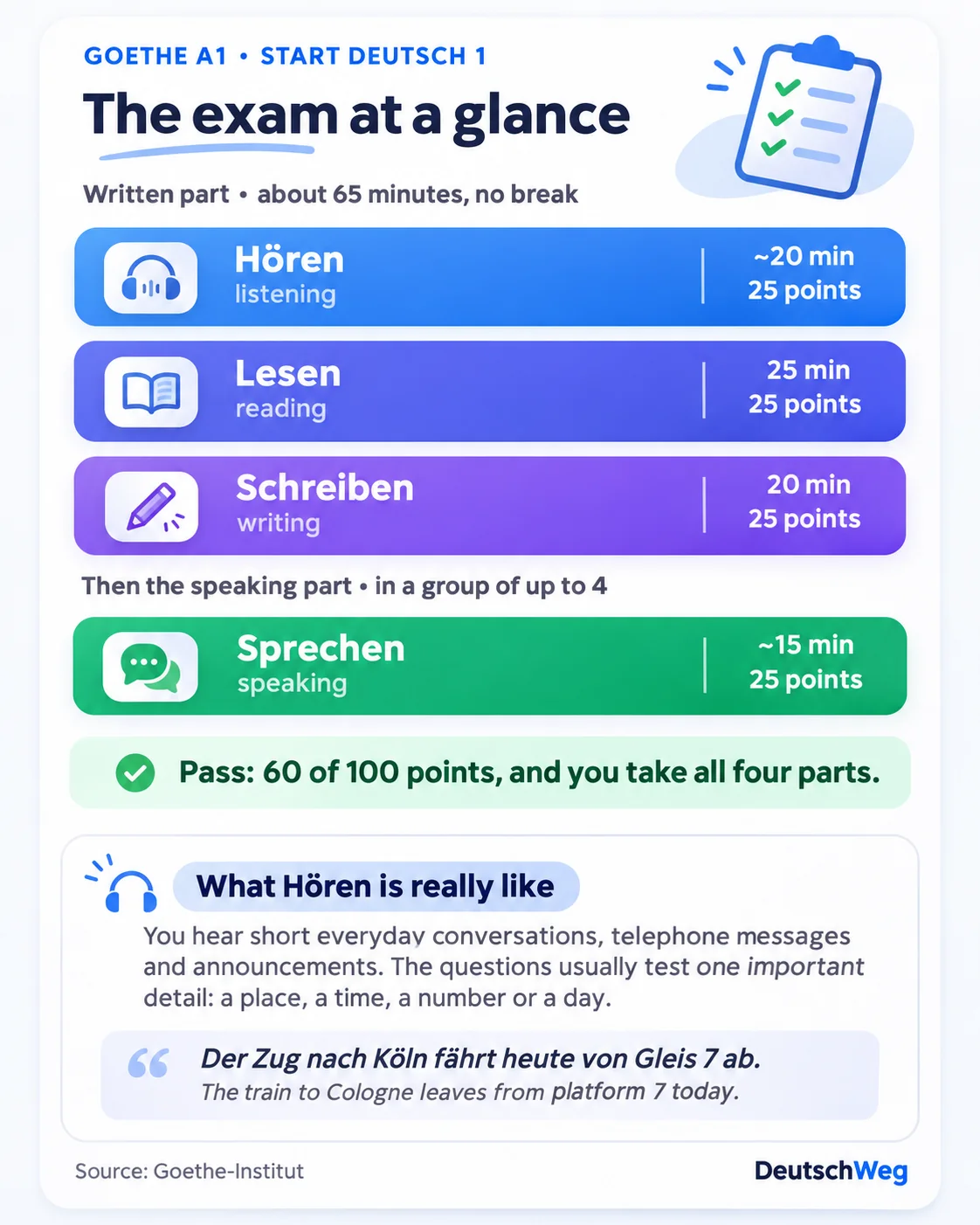
The Goethe-Zertifikat A1: Start Deutsch 1 has four parts. The first three are written and taken together, in about 65 minutes without a break. Speaking is a separate group exam.
- Hören (listening): about 20 minutes
- Lesen (reading): 25 minutes
- Schreiben (writing): 20 minutes
- Sprechen (speaking): about 15 minutes, in a group of up to four candidates, with no preparation time
Each part is worth 25 points, so the maximum is 100. You pass with 60 points, and you must take all four parts. That means you do not need to be perfect anywhere: a weak part can be balanced by a stronger one.
Hören: everyday German, not the news
You hear short everyday conversations, telephone messages and announcements, like the ones at a train station or in a shop, and answer questions about them.
A typical announcement sounds like this: „Der Zug nach Köln fährt heute von Gleis 7 ab.“ (The train to Cologne leaves from platform 7 today.) The question is usually about one detail: which platform, what time, which day.
What to practise first: numbers, times and days. Most Hören questions turn on them. If you can catch siebzehn versus siebzig, or Dienstag versus Donnerstag, you will get many points.
Lesen: notes, ads and signs
You read short texts from daily life: a note from a friend, small advertisements, signs and posters, and answer questions about them.
For example, a sign on a shop door: „Öffnungszeiten: Mo–Fr 9–18 Uhr, Sa 10–14 Uhr“. The question might be: Can you shop there on Saturday at 15:00? (No.)
What to practise first: read the question before the text. You rarely need to understand every word. You need to find one piece of information.
Schreiben: a form and a short message
The writing part has two tasks. First you fill in a simple form, using information from a short text. Then you write a short message about an everyday situation, for example to a friend.
A short message can be as simple as this:
„Liebe Anna, ich kann am Samstag leider nicht kommen. Ich bin krank. Können wir am Sonntag Kaffee trinken? Viele Grüße, Grace“
What to practise first: answer every point the task asks for. The message usually lists three things to write about. Short, simple sentences that cover all three are better than long sentences that miss one.
Sprechen: three short tasks in a group
You sit with up to three other candidates and two examiners. There are three parts:
- Introduce yourself: name, age, country, where you live, languages, job, hobby. For example: „Ich heiße Grace. Ich komme aus Kenia und wohne in Nairobi.“
- Ask and answer questions about everyday topics, using word cards. With the card Frühstück you might ask: „Was essen Sie zum Frühstück?“
- Ask someone for something: a polite request, for example „Können Sie bitte das Fenster öffnen?“
Examiners care most about whether you complete the task and can be understood. Small grammar mistakes matter less at A1. Read more in how the A1 Sprechen exam is scored.
“I understand when I read, but I freeze when I listen or speak”
This is the most common worry we hear, and it is normal. Reading lets you go at your own speed. Listening and speaking do not. The answer is not more grammar. It is short, regular practice with real exam-style tasks, so the format stops being a surprise.
Ten minutes a day is enough to start. What matters is that you practise the parts that feel hardest, not only the ones that feel comfortable.
Your 10-minute start today
- 3 minutes: say your self-introduction out loud: name, age, country, city, languages, job, hobby. Twice.
- 5 minutes: do one free A1 listening exercise below and notice which numbers or times you missed.
- 2 minutes: write a three-line message to a friend: why you cannot come, what you suggest instead, a greeting.
That is one small win in three of the four parts. Do it again tomorrow.
Practise for this step
Try a free A1 listening exercise (about 5 minutes) Free · no account Start →More practice
Keep reading
Sources
- Goethe-Institut – Goethe-Zertifikat A1: Start Deutsch 1, exam sections
- Goethe-Institut – Durchführungsbestimmungen Start Deutsch 1 (Stand 1.9.2025, PDF)
- Goethe-Institut – Prüfungsziele und Testbeschreibung Start Deutsch 1 (PDF)
Last checked: November 2026
Exam rules and formats can change. Please check the current details with the Goethe-Institut or your exam centre.