If this sounds familiar, the problem is not you
Most study plans quietly assume free evenings and plenty of energy. When a plan asks for an hour you do not have, every missed day feels like failing. After a few of those days, it is easy to stop completely.
So here is the idea this article is built on: you don't need a perfect schedule to make progress in German. You need a small, realistic step you can repeat.
Why small steps add up
Learning research has shown the same thing for decades: practice spread over many short sessions is remembered better than the same amount of time in one long session. Each time you come back to a word or a sentence, it gets a little easier to recall.
For you, that means fifteen minutes on four evenings can do more than one exhausted hour on Sunday. It also means a short session still counts.
A flexible 15-minute routine
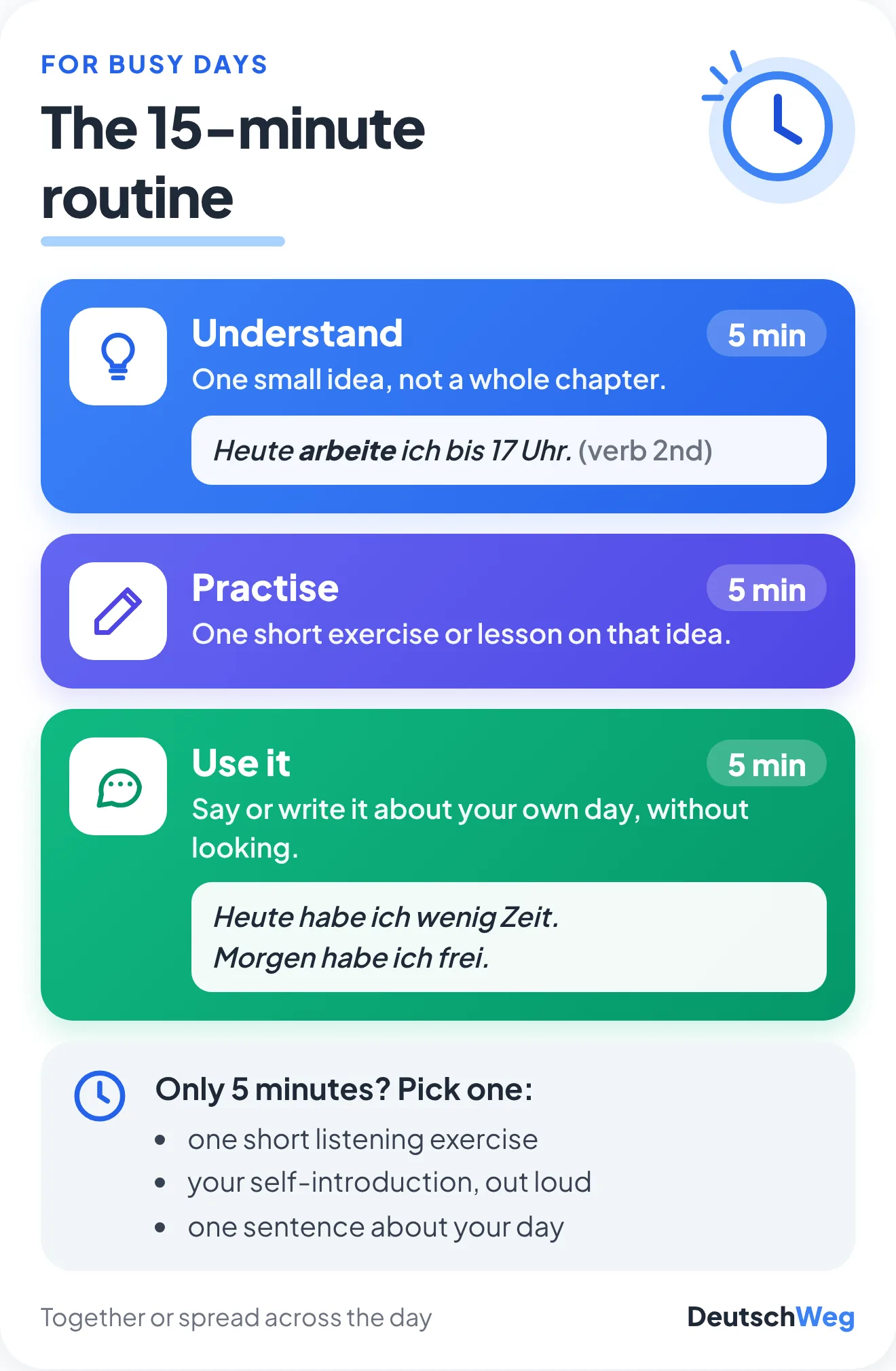
Use three small blocks of about five minutes. Do them together, or split them across the day.
- Understand (5 minutes): look at one small piece of German. Not a whole chapter, just one idea. For example, the verb comes second in a German sentence: „Heute arbeite ich bis 17 Uhr.“ (Today I work until 5 p.m.)
- Practise (5 minutes): do one short exercise on that idea, or one short lesson.
- Use it (5 minutes): say, write or remember it without looking. Make two sentences about your own day: „Heute habe ich wenig Zeit.“ (Today I have little time.) „Morgen habe ich frei.“ (Tomorrow I am off.)
The order matters less than the habit. Some days you will only manage one block. That is fine.
Make it fit your day
- On the bus or train: the understand block, on your phone.
- In your lunch break: one short exercise.
- While the pasta cooks: say your two sentences out loud, or record them as a voice message to yourself.
- With your children: name things together in German: der Tisch, die Tür, das Fenster. Small children often enjoy it, and you say the words more often than you would alone.
On the hardest days: the 5-minute version
When you only have five minutes, pick one of these and stop there:
- do one short listening exercise;
- say your self-introduction out loud: „Ich heiße … Ich komme aus … Ich wohne in …“;
- read five words from a note on the fridge, then say them without looking;
- write one sentence about your day: „Heute war ich sehr müde, aber ich habe Deutsch gelernt.“ (Today I was very tired, but I studied German.)
Five minutes keeps the habit alive. Tomorrow you start again from there, not from zero.
Notice your progress
When time is short, progress is easy to miss. Keep a simple note: the date and one thing you can say now that you could not say before. „Ich arbeite von 8 bis 16 Uhr.“ is one. After two weeks, read the list back. It is usually longer than you expect.
Remember why you started
Maybe it is a visa, a job, a training place, or talking to your child's teacher in German. Write your reason in one sentence and keep it where you study. On a tired evening, that sentence helps more than any app reminder.
Your first 15 minutes, tonight
- Understand: „Ich habe Zeit“ means I have time; „Ich habe keine Zeit“ means I have no time.
- Practise: do the short lesson below.
- Use it: say out loud: „Heute habe ich wenig Zeit, aber ich lerne fünf Minuten Deutsch.“ (Today I have little time, but I am learning German for five minutes.)
Then stop. Come back tomorrow for the next small step.
Practise for this step
Start a short A1 lesson: Mein Tag und meine Zeit (my day and my time) Free · no account Start →More practice